India's traditional companies are now moving full scale into the renewable and alternative energy space that had been dominated by smaller players over the past decade. Companies such as government-owned NTPC and the Adani and the Tata groups restructured their businesses well in time to become major players in the green space. At the same time, other conventional companies, such as Larsen & Toubro and Reliance Industries Ltd (RIL), which have a presence both in the energy sector as well as myriad other activities - construction, technology and retailing - are tying up with new-age companies to hitch a ride to a greener path.

Automobile companies are worried about challenges from electric mobility, automation and connected vehicles.

'The Budget will be positive, continuing on the path of growth taken so far.'

This, my friends, is the ultimate off-road champion, gloats Rajesh Karkera/Rediff.com.

Roads are becoming smarter even if the people driving on it are not. A set of smart technologies is making construction, maintenance, and traffic management much more efficient.

US hedge fund Tiger Global and Japanese investment giant SoftBank have trimmed their investments in Indian start-ups by over a third - from $3.8 billion in the second half of 2021 to a mere $1.08 billion in H1 2022, according to data from Venture Intelligence. While SoftBank's investments in India dropped from $1.9 billion in H2 2021 by more than a fifth to only $0.33 billion in H1 2022, that of Tiger Global fell from $1.92 to $0.74 billion in the same period. Private equity (PE) fund trackers point out that this year most of the deals that Tiger Global has invested in are in the early stage (up to series D), and only a few are in the series E and above.

By industry estimates, less than five per cent of the passenger car market in India would comprise electric cars over the next five-seven years, at 1,75,000 units, when the industry size would double to 3.5 million units, as against over 1.6 million in 2009.

With rising petrol and diesel prices driving up demand for its CNG vehicles, the country's largest carmaker Maruti Suzuki India plans to widen its CNG portfolio by offering the fuel option in four more models 'very shortly', according to a senior company official. The company, which plans to launch an electric vehicle (EV) in the Indian market by 2025, is also currently keeping a close watch on the country's EV ecosystem "to find out what is the best way of evolution" to be able to offer affordable EVs with hassle free charging infrastructure in order to clock high volumes for a sustainable business.

Only a few thousand chargers dot the Indian landscape, some in working condition, others not, with some held hostage to the power supply vagaries of local utilities, reports S Dinakar.

A variant of the e2o could be exported to the Middle Kingdom, Europe next year.
'We crossed Rs 1.7 trillion in three months this financial year.'

The demand for buses largely remained robust in 2023, driven by the increasing need for public mobility and replacement. Ashok Leyland Limited (ALL) recorded a 64 per cent year-on-year increase in sales of medium and heavy commercial vehicle (MHCV) buses during the April-to-December period of 2023 to 11,216 units. Volvo Eicher Commercial Vehicles (VECV) posted 24.7 per cent sales growth between April and December for light and medium-duty buses, and 36.9 per cent growth for heavy-duty buses.

Bajaj Auto, the king of the market for CNG-powered passenger three-wheelers, now wants to replicate this dominance in two-wheelers. The difference is that while the former is zooming - registrations for CNG-powered passenger three-wheelers nearly doubled during January-December 2023 - the latter, meaning a market for CNG-powered two-wheelers, does not exist.

GST will yield 'better value for money' for car buyers, increasing automobile industry demand, says Sandip Neogi.

In the midst of third wave of COVID-19, Finance Minister Nirmala Sitharaman has come up with an impactful Budget which is balanced, fiscally prudent and growth-oriented, the USA India Chamber of Commerce has said. President of the Boston-based USA India Chamber of Commerce (USAIC) Karun Rishi, however, said it is a matter of concern that the budget lacks tangible measures to increase revenue generation. "Opting to keep the fiscal deficit at 6.9 per cent and increase capital expenditure by 35 per cent is a masterstroke. "The annual budget estimates the effective capital expenditure of Rs 10.68 lakh crore in 2022-23, making up about 4.1 per cent of the GDP," he said. "A phenomenal increase in the government's capital expenditure is likely to facilitate the expenditures on infrastructure and create jobs.

South Korean auto giant Hyundai Motor Company is considering tax implications of listing its Indian unit before taking a final call, according to sources privy to the development. Hyundai Motor is mulling an initial public offering (IPO) for its Indian arm to raise around $3 billion (at a valuation of up to $30 billion), and talks are in the early stages between the company and bankers, banking sources revealed. Hyundai Motor India Ltd (HMIL), however, declined to comment on the development.
General Motors' Saturn Aura won the 'Car of the Year' at the North American International Auto Show this year.

As part of efforts to curb pollution, the Centre is in the final stage of completing the Rs 10 crore pilot project under which 10 refurbished electric buses will be handed over to select State Transport Corporations by March 2016.
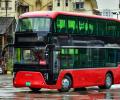
Seeking to enhance green mobility, the Union Cabinet on Wednesday approved the 'PM-eBus Sewa' scheme under which 10,000 electric buses will be provided to 169 cities under the public-private partnership (PPP) model.
The e2o, an all-electric, four-seater passenger car, will be the first model under the Mahindra Reva stable to be launched.

'I have personally been very keen on investing in lithium ion battery technology for some time.'

The vehicle would be the electric version of General Motors' small car 'Spark'. Reva would provide battery technology for the E-Spark.

'The success of one or two IPOs does not dictate whether the upcoming IPOs will be successful or not, but it certainly indicates that the markets and investors are enthusiastic about startup IPOs.'

Earlier in May, Ford India announced that it had dropped its plans to make electric vehicles (EVs) in India, which it intended to export, under the production-linked incentive scheme (PLI). Ford was among 20 companies that had signed a Champion OEM Incentive Scheme under the PLI project with the government in February this year. The decision comes as a blow for the 4,000-odd employees at Ford India's Maraimalai Nagar plant near Chennai and in Sanand, Gujarat. In September last year, the company had announced that it would exit the India market, which it had entered in 1995 through an on-again, off-again joint venture with Mahindra & Mahindra (they split in 1998, signed a JV in 2019 and split again in December 2020), retailing petrol and diesel brands such as the EcoSport, Figo, Aspire, and Endeavour.
